Caring for Elderly Parents' Health Records: The Hidden Job
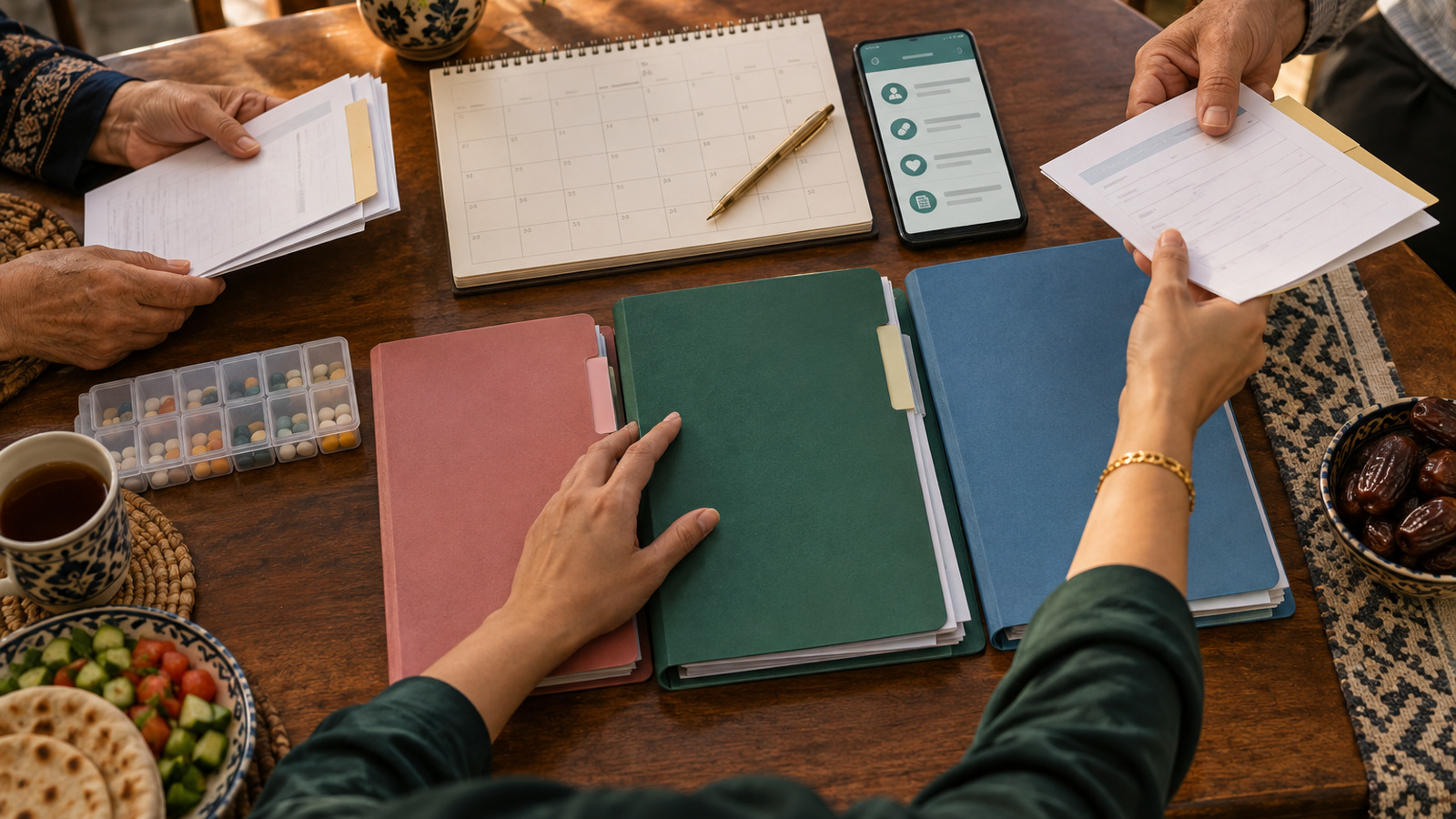
In most families, one person ends up holding everyone's lab reports, medicine lists and doctors' names. The job gets hard not because the information is missing, but because it's organised by where it came from instead of by the person it belongs to. Organising it by person, in one place, is what makes it manageable.
There's a sentence that keeps appearing in online communities for people who look after a parent.
It usually comes after a long story about hospital visits and medicine lists.
My parents never made a plan. I became the plan.
Nobody applies for this job.
It arrives quietly. A father who can't remember the name of his new tablet. A mother whose specialist asks, "When was your last thyroid test?" and everyone in the room looks at you.
From that moment, you're the family health manager.
Why does one person end up holding everyone's health information?
Because health care is organised around visits, and families are organised around people.
Each clinic keeps its own file. Each lab sends its own report. Each doctor sees the part of the story that walked into their room that day.
Nobody in that system is responsible for the whole picture.
So the whole picture ends up with whoever is closest, most organised, or simply most worried. Often it's a daughter. Often it's the child who lives nearest. Increasingly, it's the one who lives abroad and feels the distance most.
This isn't a local quirk. It's where health care everywhere is heading.
The World Health Organization expects the number of people aged 60 and over to grow from 1 billion in 2020 to 2.1 billion by 2050. It also notes something every caregiver already knows: as people age, they're more likely to live with several conditions at the same time.
Several conditions means several doctors.
Several doctors means several files.
And several files means someone, somewhere, is quietly holding it all together.
What makes the family health manager's job so hard?
Here's the part most people miss.
The problem is rarely a lack of information. Most families have plenty.
A folder of printouts. PDFs in three email accounts. Photos of reports sitting in a WhatsApp chat between voice notes and wedding invitations. A notebook with medicine names and a few crossed-out doses.
The information exists. It's just organised in the wrong direction.
It's filed by source — this lab, that clinic, that message from your brother — instead of by person.
Think about what that means in practice.
When the cardiologist asks what your father's last cholesterol result was, you don't need "the lab folder." You need "everything about Baba, in date order."
When your mother starts a new medicine, the question isn't "where's the prescription?" It's "what else is she already taking, and who prescribed it?"
Every useful question a family health manager gets asked is a question about one person, over time.
Every storage system most families use answers a different question: where did this piece of paper come from?
The wrong question, and the better one
So the question most caregivers start with is:
"Where do I keep all these papers?"
It sounds practical. It leads to bigger folders, more labelled envelopes and a spreadsheet that's out of date by the second appointment.
The better question is:
"Where does everything about this person live?"
That shift changes what you collect, how you file it and what you can answer on the spot.
How the job actually works, step by step
Look closely at what a family health manager does, and it's a chain.
1. Collect. Reports arrive from different places, in different formats, sometimes in two languages.
2. Attach. Each report has to be linked to the right person and the right date. This is where things quietly go wrong — a sister's report filed under a mother's name, an old result mistaken for a new one.
3. Read. Someone has to understand what's on the page, well enough to notice what matters.
4. Connect. The value on today's report only means something next to last year's, and next to the other results that tend to move with it.
5. Carry. All of it has to be ready when a doctor, a pharmacist or a worried relative asks.
Most families do steps 1 and 5, because they're unavoidable. Steps 2 to 4 are where the job gets heavy, because they depend on memory.
And memory is exactly what fails under stress, in a waiting room, at 11 pm, when someone calls with bad news.
What does good organisation look like?
Public health guidance has recommended personal health records for years. MedlinePlus, the US National Library of Medicine's consumer site, describes a personal health record as a way to keep track of information that's otherwise spread across different providers, and suggests including things like test results, current medicines and doses, allergies, major medical events and family history.
Notice what that list has in common. Every item belongs to one person.
A practical version for a family looks like this:
- One record per person. Not one folder for "the family."
- Dates on everything. A result without a date is almost useless for comparison.
- Reports kept whole. The original page, including the range the lab printed, not just a number copied into a notebook.
- A current medicine list. Name, dose, timing and who prescribed it.
- Contacts in one place. Doctors, the lab you usually use, emergency contacts, insurance details.
- A way to see change. The same test, lined up across years.
The last point is the one paper does worst. We explore why in Trajectory, Not Snapshot.
The emotional side nobody mentions
It would be easy to write this as a filing problem.
It isn't only that.
Carrying a family's health history is carrying responsibility without authority. You're expected to know everything, while decisions sit with doctors and with the parent themselves.
Many caregivers describe a specific kind of guilt: the fear that something important was sitting in a folder all along, and they didn't see it in time.
The honest answer is that no system removes that feeling completely. But a system can remove the part that comes from disorganisation — the scramble, the missing page, the "I think it was last spring."
What's left is the part that belongs to love, not logistics.
What this means for you
If you're the family health manager, three changes make the biggest difference:
- Switch from source to person. Start one record per family member, even if it begins with just the last report.
- Collect the history, not only the latest page. Old reports are worth more than they look, because they turn single numbers into direction.
- Prepare questions, not conclusions. Your job isn't to interpret results for your parent. It's to make sure the doctor sees the full picture, and that nothing important goes unasked. More on that in Before the Appointment.
Where mySEHA fits
This job is the reason mySEHA exists.
In my own family, I'm the one who carries everyone's reports. The tool I wanted didn't exist in a form that worked for Egyptian families: mixed Arabic and English reports, several labs, relatives in different cities and countries.
mySEHA is built around the person, not the paper. One account holds a separate profile for each family member you look after, each with its own permanent Health ID. You photograph or upload a report from any lab, confirm the values, and it's filed under that person and date. Results are explained in plain Arabic or English, against the range that lab printed and alongside earlier results. Each profile can also hold medicines with reminders, prescriptions, scan reports, vaccination records, insurance cards and emergency contacts, and you can export a clean PDF for a doctor.
It's a record and an explanation, not a medical opinion. mySEHA does not diagnose, does not name a condition, does not prescribe, and does not replace a doctor.
By person, not by paper. If you're already the one holding the folder, that's exactly where we'd start.
Key takeaways
- In most families, one person becomes the family health manager, usually without choosing to.
- The difficulty isn't missing information; it's information organised by source instead of by person.
- The better question is "where does everything about this person live?", not "where do I keep these papers?"
- A useful family record has one profile per person, dated reports with their printed ranges, a current medicine list and a way to see change over time.
- The caregiver's role is to make sure the full picture reaches the doctor, not to interpret results alone.
Frequently asked questions
What should a personal health record for a parent include?
At minimum: dated lab reports kept whole (including the lab's printed ranges), a current list of medicines with doses and who prescribed them, allergies, major medical events, doctors' contacts and emergency contacts. MedlinePlus also suggests family medical history and screening results.
Should I keep my parents' records in one family folder or separate ones?
Separate records per person work far better. Almost every question a doctor asks is about one person over time, and mixing people in one folder is how reports end up filed under the wrong name.
Is it okay to manage my parent's health records for them?
In practice, many families do, but ask your parent first. Health information is personal, and a parent who knows their records are being organised is usually more willing to share the next report and medicine list.
Where this comes from
- World Health Organization. Ageing and health (fact sheet)https://www.who.int/news-room/fact-sheets/detail/ageing-and-health
- MedlinePlus, US National Library of Medicine. Personal Health Recordshttps://medlineplus.gov/personalhealthrecords.html
- MedlinePlus. Caregivershttps://medlineplus.gov/caregivers.html
- MedlinePlus. Older Adult Healthhttps://medlineplus.gov/olderadulthealth.html
Read your own results in context.
An article explains the general picture. mySEHA reads your own results together — connecting them, in Arabic or English.
Join the waitlist →