Managing Parents' Health From Abroad: Seeing It From Afar
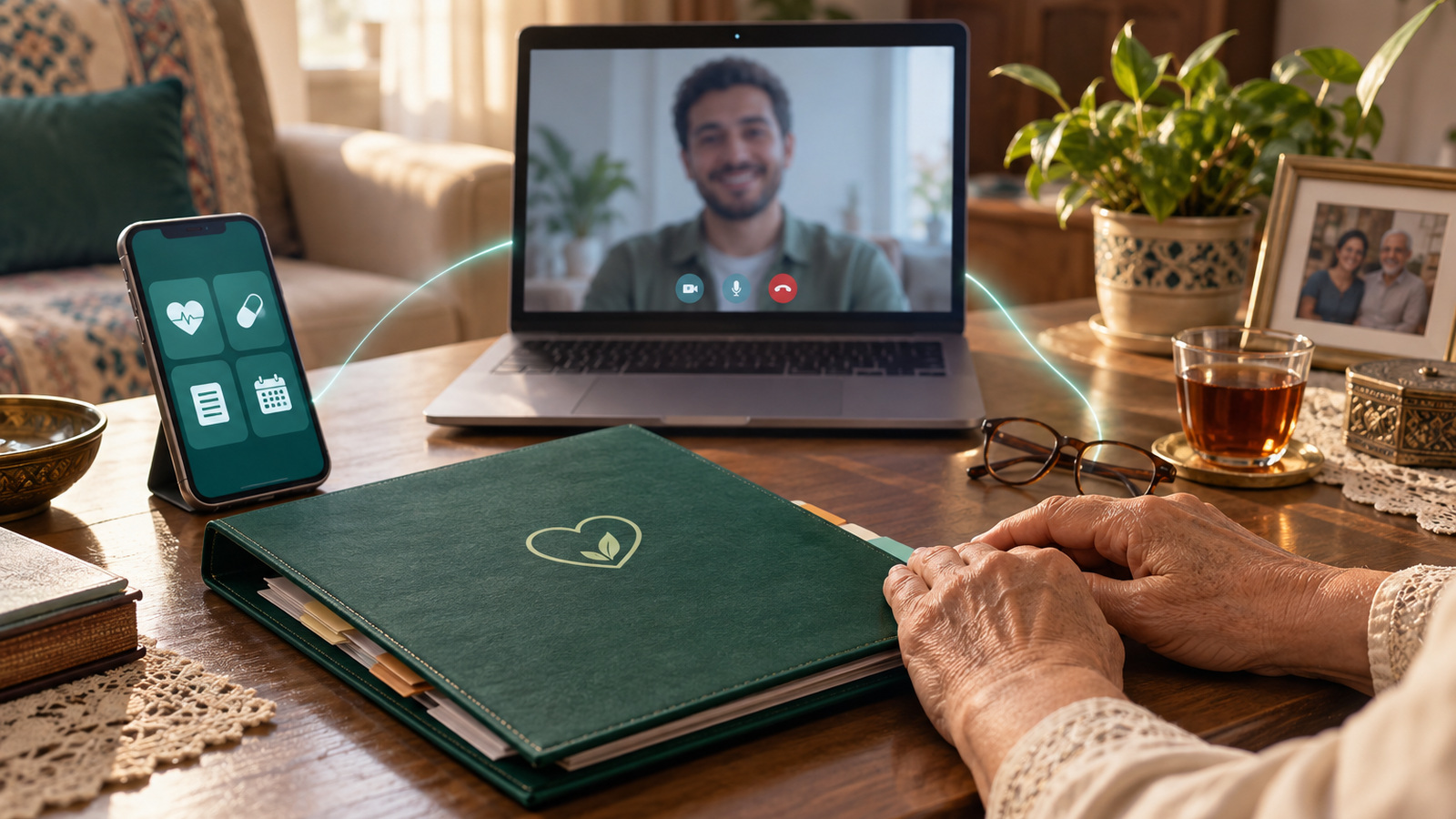
When you live abroad, the hardest part of caring for parents usually isn't the emergency. It's the months before it, when small changes happen and you can't see them. Keeping each parent's reports and medicines in one shared place, before anything urgent happens, lets you follow the picture instead of waiting for the news.
You're in Dubai.
Your parents' health is in Cairo.
Most weeks, that distance is manageable. A video call on Friday. A few voice notes. "Everything's fine, habibi."
Then one evening a message arrives from your sister. A photo of a lab report, slightly blurred, taken on a kitchen table.
"Mama did some tests. The doctor said to repeat one. Don't worry."
And you do exactly what she asked you not to do.
Why is caring for parents from abroad so stressful?
Millions of Egyptians live and work in the Gulf, Europe and North America. Many of them have parents at home.
On Reddit's Egypt community, someone once asked a question that sounded simple: how do you take care of elderly parents when you live abroad?
The replies were practical and kind. Find a reliable helper. Visit more often. Ask a relative to check in.
What almost nobody had an answer for was the information itself.
Who has the latest report? What changed since your last visit? Which medicine did the new doctor add? Is this result new, or has it looked like this for years?
Those questions don't need you to be physically present. They need the history to be visible.
Here's what distance really hides
The common assumption is that distance makes emergencies worse.
It does, but that's not where most of the stress comes from.
The deeper problem is that distance removes the small, continuous signals you'd pick up if you lived nearby.
You'd notice your father using a new tablet box. You'd hear about the repeat test before it happened, not after. You'd see a report on the table and ask about it.
From abroad, you receive health information in bursts, usually when something has already prompted a conversation.
And bursts are exactly the wrong format for health.
A single report is a snapshot. The useful part of a parent's health story often sits between reports: a value that has crept up gradually for three years, or a medicine change that explains a new result. When you only see the report that triggered a worried phone call, you're seeing the end of the story without the chapters before it.
The wrong question, and the better one
So most people living abroad ask:
"How do I find out faster when something happens?"
That leads to more phone calls, more "just checking" messages and a constant low-level anxiety.
The better question is:
"How do I see the picture before anything happens?"
It moves you from reacting to following. From news to context.
How following from abroad actually works
Look at the chain of events when a parent in Egypt gets tested and a child abroad wants to understand it.
1. The test happens. Often at a lab near home, sometimes a different lab each time.
2. A report is printed or sent. Frequently mixed Arabic and English, with that lab's own reference ranges. We explain how to read those in Reading an Egyptian Lab Report.
3. Someone photographs it. Usually a sibling, a parent, or a neighbour who's good with phones.
4. It travels. Almost always by WhatsApp.
5. It gets lost. Buried under other messages within a week. Next year, nobody can find it.
6. The next report arrives alone. With nothing to compare it to.
The break in the chain is step 5. Every report that isn't kept whole, dated and attached to the right person is a chapter you'll never be able to reread.
So the most valuable habit for a family abroad isn't checking in more often.
It's making sure every report ends up in the same place, under the right person, the day it arrives.
What a good long-distance setup looks like
Families who handle this well tend to agree on a few simple things.
One coordinator at home, one keeper of the record. Often they're different people. The sibling in Egypt handles appointments; the one abroad keeps the history organised.
A rule for reports. "Every report gets photographed the same day and sent to one person." Simple rules survive busy weeks.
A current medicine list. Updated whenever a doctor changes something. From abroad, this list is often the single most useful thing you can hold.
Doctors' contacts and the usual lab. So you know who to call and where old results are.
Consent from your parents. Health information is personal. A parent who knows and agrees is far more likely to share the next report. We cover how to have that conversation in Talking to Your Parents About Their Health Records.
A way to prepare for appointments remotely. Before a doctor's visit, you can help list what's changed and what to ask, even if you can't be in the room.
What this means for you
You can't be in Cairo every week.
You can still be the person who sees the whole picture.
The shift is small but real. Stop measuring your involvement by how quickly you hear news, and start measuring it by how complete the history is. When the next report arrives, it lands next to the last five, and the question "is this new?" has an answer.
That's what reduces the worry. Not more calls. More context.
Where mySEHA fits
This is one of the situations mySEHA was built for.
With mySEHA, you keep a separate profile for each parent in your account. When a relative sends a report as a photo or PDF, you upload it to that parent's profile and confirm the values. The app files it by date and explains the results in plain Arabic or English, against the range that lab printed, alongside their earlier results. From wherever you live, you can see how things have changed since your last visit, keep their medicines and reminders in order, and export a clean PDF to send to their doctor in Egypt before an appointment.
A few honest limits. Reports aren't forwarded into the app from WhatsApp directly; you upload the photo or PDF. And today this works through your account holding the family's profiles. Letting a parent or sibling give you direct view access to their own separate account is planned for a later phase.
mySEHA does not diagnose, does not name a condition, does not prescribe, and does not replace a doctor. Medical decisions stay with the doctor who examines your parent.
Peace of mind, not just news. If your family's reports are currently living in a chat thread, that's the first thing worth moving.
Key takeaways
- The main challenge of caring from abroad is not the emergency, but the invisible months before it.
- Health information reaches families abroad in bursts, which strips away the context that gives a result meaning.
- The better question is "how do I see the picture before anything happens?", not "how do I hear news faster?"
- Agree a simple family rule: every report is photographed the day it arrives and kept under the right person.
- A current medicine list and a complete, dated history are the most useful things someone abroad can hold.
Frequently asked questions
How can I follow my parents' lab results if I live in another country?
Agree with a relative at home that every report is photographed and sent to you the day it arrives, then keep each one filed under the right parent and date. Over time, this gives you a history you can compare, not just isolated reports.
What's the most useful health information to keep when caring from a distance?
A current medicine list (with doses and who prescribed them), dated lab reports with the lab's printed ranges, doctors' contacts and emergency contacts. Together they let you answer most questions without being in the room.
Can I talk to my parent's doctor in Egypt from abroad?
Many doctors are open to a call or to receiving a written summary, especially if your parent agrees and is present. Preparing a short list of what has changed and what you want to ask makes that conversation far more useful.
Where this comes from
- World Health Organization. Ageing and health (fact sheet)https://www.who.int/news-room/fact-sheets/detail/ageing-and-health
- MedlinePlus, US National Library of Medicine. Caregivershttps://medlineplus.gov/caregivers.html
- MedlinePlus. Personal Health Recordshttps://medlineplus.gov/personalhealthrecords.html
Read your own results in context.
An article explains the general picture. mySEHA reads your own results together — connecting them, in Arabic or English.
Join the waitlist →