How to Read a Lab Report: The Four Parts of Every Line
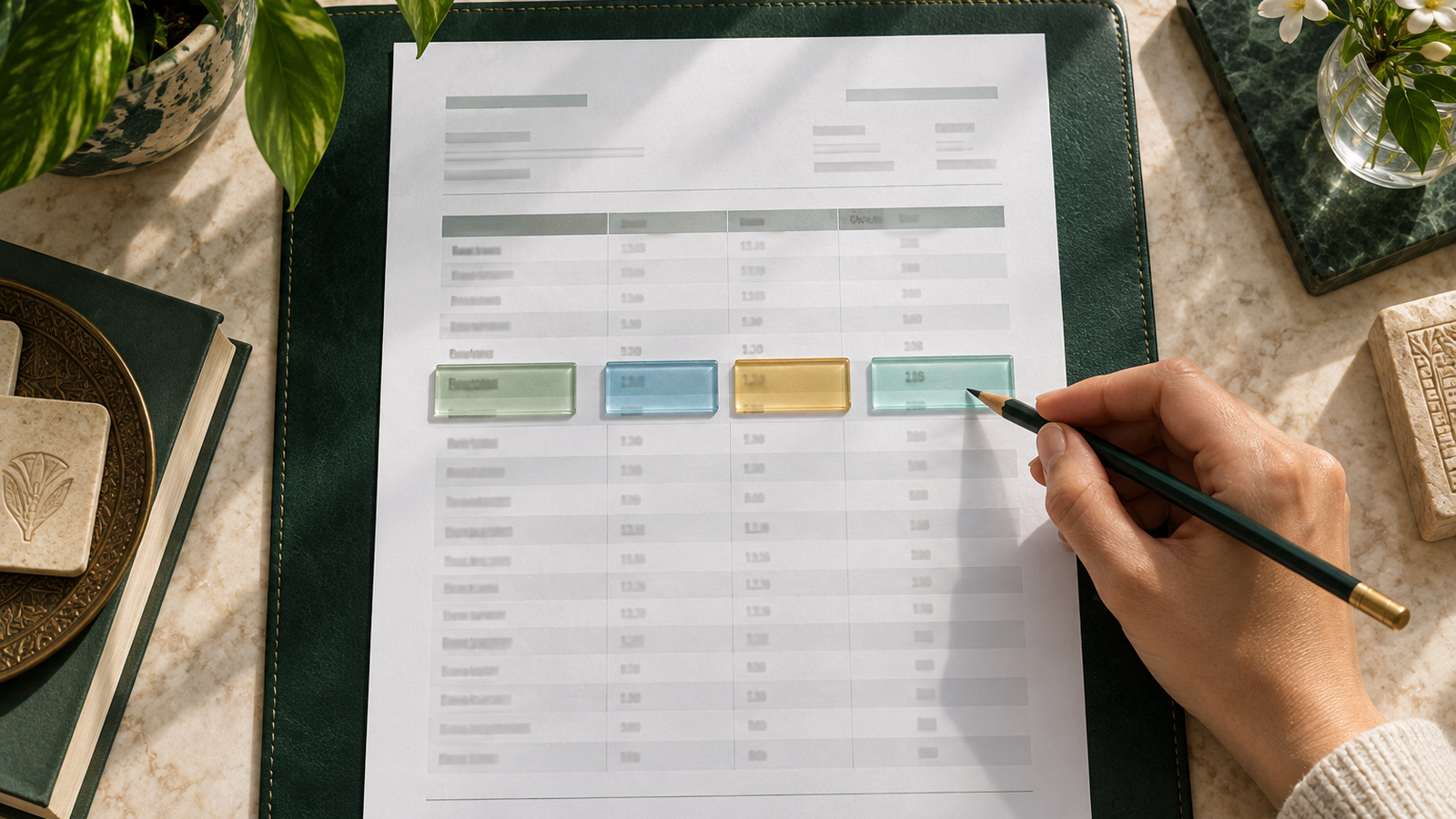
Every line on a lab report has four parts: the test name, your value, the unit, and the reference range your own lab printed. Read the flagged lines first, then check how far outside the range they are, then compare with an older report. That order turns a page of numbers into a few clear questions for your doctor.
Here's a small experiment.
Find your last blood test. The real page, not the doctor's one-line summary.
Now try to answer three questions without looking anything up. Which value is furthest from its range? Which unit is it measured in? Has it gone up or down since the report before?
Most people can't answer any of them. Not because they aren't smart. Because nobody ever showed them how a report is built.
Why do so many people struggle to read their own results?
Lab reports were designed for clinicians, not for the person the blood came from.
That made sense when results went from the lab to the doctor and only the doctor's interpretation reached the patient. It makes less sense today. Around the world, results now arrive directly on people's phones — as a PDF from the lab, a patient-portal notification, or a photo in a family WhatsApp group — often before anyone has explained them.
So the information has moved to the patient. The skill to read it hasn't.
That gap is where most of the anxiety comes from. A page of forty numbers with a few in bold looks like a verdict. It's actually a document with a very simple structure.
What are the four parts of a lab report line?
Take any single line. It almost always contains the same four things.
1. The test name. Often abbreviated — HGB, TSH, ALT, HbA1c. Some reports print the full name, some only the code, and many Egyptian reports mix English test names with Arabic headings.
2. Your value. The number measured from your sample. Sometimes it's not a number at all but a word, like "Negative" or "Not detected".
3. The unit. What the number is counted in: g/dL, mmol/L, ng/mL, cells per microlitre. The same substance can be reported in different units by different labs, and the number changes completely when the unit does (more on that in our guide to units).
4. The reference range. Two numbers that mark the lower and upper ends of what that lab considers typical for its reference group. Sometimes only one limit is printed, like "< 5.0".
Many reports add a fifth element: a flag. An H or L, an asterisk, or bold text marking values outside the range.
That's the whole anatomy. Everything else on the page — patient details, sample time, the lab's name, the doctor's name — is context.
Here's the part most people miss: the range belongs to your lab
This is the single most useful thing to understand about any report.
A reference range isn't a universal law of the body. Each laboratory sets its range from results in a reference group, using its own analysers, chemical reagents and methods. In the standard approach, the range is the central 95% of results from that healthy reference population.
That has two consequences.
First, a range you find online may not match your lab's. Lab-to-lab differences in equipment and methods mean the same test can carry a different range from one laboratory to another, which is why laboratory professionals advise reading your result against the range printed by the lab that did the test.
Second, because the range covers the middle 95% of healthy people, about 5% of healthy people fall outside it on any given test. A result outside the range is a reason to look closer, not proof that something is wrong. (We go deeper on this in what a flagged result actually means.)
The wrong question, and the better one
When people open a report, they ask: "Is anything abnormal?"
It's a natural question. It's also the least useful one, because it treats every flag as equal and every unflagged value as settled.
The better question is: "What exactly should I understand before I talk to my doctor?"
That question has a method.
In what order should you read a lab report?
Here's a sequence that works for almost any report.
Step 1: Confirm it's your report and note the date
Check the name, the date the sample was taken and, if printed, whether you were fasting. Timing matters: many values move with meals, time of day, exercise and medicines. MedlinePlus lists eating and drinking, some medicines and supplements, hard exercise, menstrual periods and not following preparation instructions among the things that can affect results.
Step 2: Find the flagged lines
Scan for H, L, asterisks or bold. Write them down. On a typical panel, that's usually a short list.
Step 3: For each flag, ask "how far?"
A value just past the edge of its range is a different conversation from one far outside it. Compare the number with the nearest limit. Is it a little outside, or a lot?
Step 4: Check the unit before comparing anything
If you're comparing with an older report or a website, make sure the units match. The same result can look very different in different units.
Step 5: Look for an older report
This is the step almost everyone skips, and it's the one that adds the most meaning. A value slightly outside its range that has been stable for five years tells a different story from one that has moved steadily in one direction. We explain why in Trajectory, Not Snapshot.
Step 6: Notice related lines
Markers often move in groups. The lines on a complete blood count relate to each other; so do the numbers on a lipid panel. A flagged value makes more sense when you look at its neighbours on the same report.
Step 7: Turn it into questions
End with three or four specific questions. Not "is this bad?" but "this value is slightly above the range and was lower two years ago — is that worth watching?"
What your report can't tell you
It's worth being honest about the limits.
A lab report doesn't contain your symptoms, your examination, your medical history or your medicines. That's why reading it well isn't the same as interpreting what it means for you. A result inside the range is reassuring, but not a guarantee; there is overlap between results in healthy people and people who are unwell. And a result outside it isn't a diagnosis.
Reading your report is about arriving informed. The interpretation belongs to a doctor who knows your history.
Why this matters more than it seems
Think about what a short appointment actually allows. A few minutes, a screen of numbers, and a lot to cover.
Now picture two versions of that appointment. In one, you walk in with a folder and a vague worry. In the other, you walk in knowing which two values are outside their ranges, by how much, and how they've changed since last year.
The second appointment is almost always more useful. For you and for the doctor.
That's the real payoff of learning to read a report: you understand, not just receive.
Where mySEHA fits
We built mySEHA because this reading takes time most people don't have, especially when the reports belong to a whole family and come from different labs.
You photograph or upload a report — Arabic, English or mixed, from any laboratory. mySEHA reads each line and shows you the values to confirm before anything is analysed, because reading a printed page is never perfect. Then it explains each result against the range your own lab printed, and only uses its own reference library when your report doesn't print one. When there's no sound range from either source, it records the value without labelling it high or low rather than guessing. It lines your results up with earlier reports so you can see direction, and it helps you turn what you see into questions for your doctor.
mySEHA does not diagnose, does not name a condition, does not prescribe, and does not replace a doctor. It helps you arrive at the appointment already understanding your own report.
If you have a report sitting in your phone right now, that's a good place to start.
Key takeaways
- Every lab line has four parts: test name, value, unit and the reference range your lab printed.
- Reference ranges are set by each lab from a healthy reference group, so use your own lab's range, not one from the internet.
- About 5% of healthy people fall outside a typical range on any one test — a flag is a reason to look closer, not a conclusion.
- Read in order: flagged lines, how far outside, units, older reports, related markers, then questions.
- Reading a report well helps you have a better conversation with your doctor; it doesn't replace that conversation.
Frequently asked questions
What does the reference range on my lab report mean?
It's the span of results the laboratory considers typical, based on a healthy reference group tested with that lab's own methods. In the standard approach it covers the central 95% of that group. Because methods and populations differ, always compare your result with the range printed on your own report.
Should I worry if one result is outside the range?
Not automatically. By design, a small share of healthy people fall outside any single range, and food, exercise, timing, medicines and recent illness can all move a value. Look at how far outside it is and whether it has changed over time, then discuss it with your doctor.
Why doesn't my report match the normal values I found online?
Online ranges usually come from a different laboratory, method or population, and sometimes a different unit. Laboratory professionals recommend using the range supplied by the lab that performed your test.
Where this comes from
- MedlinePlus (U.S. National Library of Medicine) — How to Understand Your Lab Resultshttps://medlineplus.gov/lab-tests/how-to-understand-your-lab-results/
- MedlinePlus — How to Prepare for a Lab Testhttps://medlineplus.gov/lab-tests/how-to-prepare-for-a-lab-test/
- Testing.com (Association for Diagnostics & Laboratory Medicine) — Reference Ranges and What They Meanhttps://www.testing.com/articles/laboratory-test-reference-ranges/
- Timbrell NE. The Role and Limitations of the Reference Interval Within Clinical Chemistry and Its Reliability for Disease Detection. British Journal of Biomedical Science, 2024https://pmc.ncbi.nlm.nih.gov/articles/PMC10932992/
Read your own results in context.
An article explains the general picture. mySEHA reads your own results together — connecting them, in Arabic or English.
Join the waitlist →