Lab Result Units Explained: Why the Same Test Looks Different
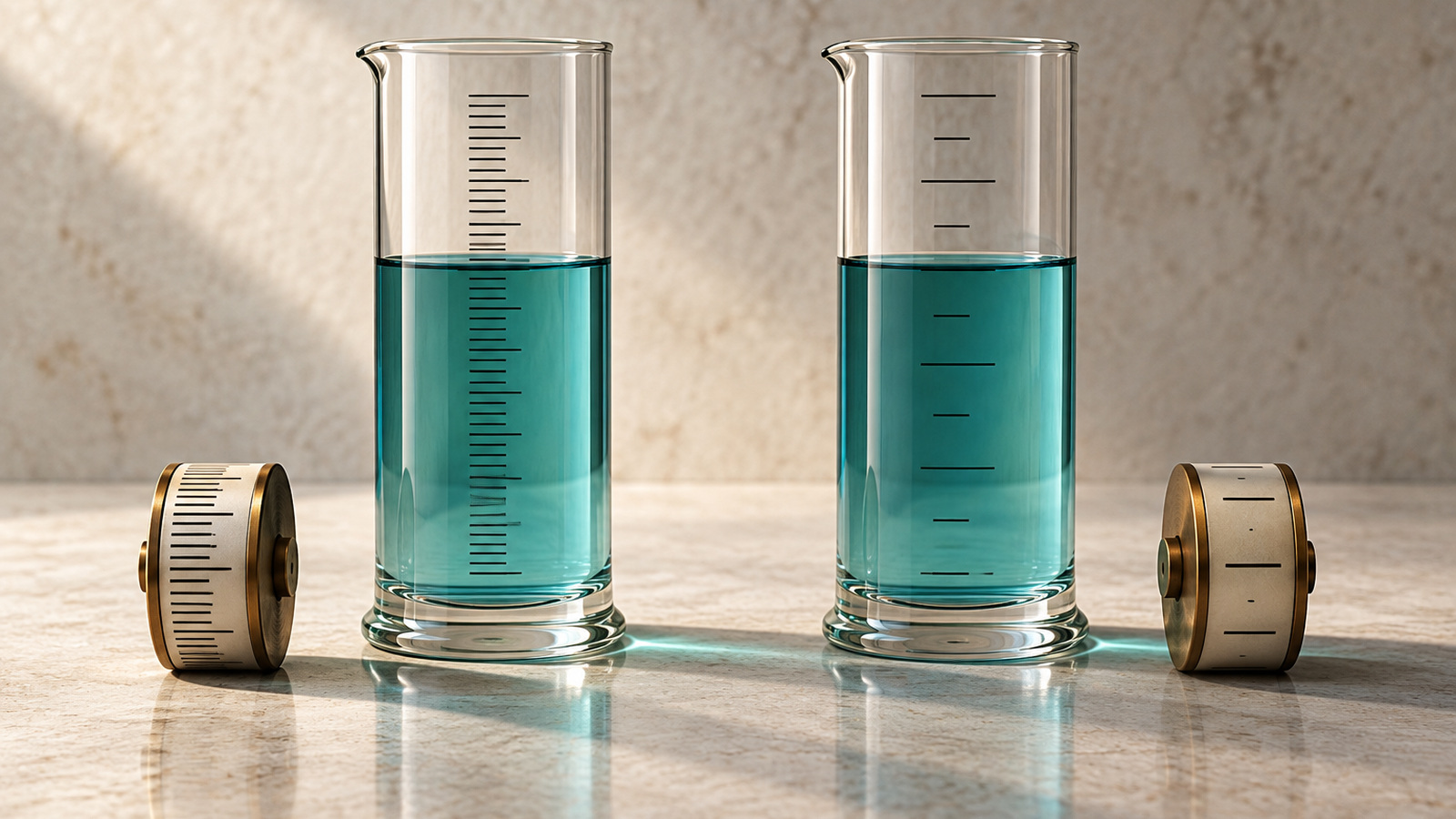
Many lab tests can be reported in more than one unit, and the number changes completely when the unit does. Glucose in mg/dL is about 18 times the value in mmol/L; vitamin D in nmol/L is about 2.5 times the value in ng/mL; HbA1c can be a percentage or mmol/mol. Always check the unit — and the range printed beside it — before comparing two results.
A result that is 90 on one report and 5 on another can be exactly the same measurement.
Nothing changed in the person. Nothing is wrong with either lab.
The only thing that changed was the unit.
It sounds like a technicality. But it's one of the most common reasons people panic about a result that is fine, or feel reassured by one they misread.
Why do lab results come in different units?
Because the world never fully agreed on one system.
Some laboratories, particularly in the United States, report many results as mass per volume — milligrams per decilitre (mg/dL), for example. Much of the rest of the world uses SI units, which count molecules — millimoles per litre (mmol/L).
Add in international standardisation programmes, manufacturer choices, and labs that serve patients who've been tested in different countries, and you get reports that describe the same substance in different languages of measurement.
For families who move between countries, or keep reports from several labs, this isn't rare. It's routine.
Here's the part most people miss: the number means nothing without its unit
A value is really two things printed side by side: a number and a unit. Read only the number, and you've read half a sentence.
A few common examples show how big the difference can be.
Glucose: mg/dL vs mmol/L
Blood glucose is reported either in mg/dL or in mmol/L. To go from mg/dL to mmol/L, divide by about 18 (the factor comes from the molar mass of glucose).
So a value of 90 mg/dL is about 5.0 mmol/L. Same sample. A number eighteen times smaller.
Vitamin D: ng/mL vs nmol/L
Vitamin D status is usually measured as 25-hydroxyvitamin D. It can be reported in ng/mL or in nmol/L. The approximate conversion is ng/mL × 2.5 = nmol/L.
So 20 ng/mL is about 50 nmol/L. If you read a guideline in one unit and your report in the other, the numbers won't line up — and it's easy to reach the wrong conclusion.
HbA1c: percent vs mmol/mol
HbA1c reflects average blood glucose over roughly the previous few months. It's reported either as a percentage (the NGSP system) or in mmol/mol (the IFCC system). They're linked by an official master equation. For example, 7.0% corresponds to about 53 mmol/mol.
White blood cells: ×10³/µL vs ×10⁹/L
Some units look different but give the same number. A white cell count written as 6.5 ×10³/µL and one written as 6.5 ×10⁹/L are numerically identical, because a microlitre is a millionth of a litre. That's the opposite trap: the units look alarming, but nothing needs converting.
Decimals, commas and "less than" signs
Units aren't the only thing that changes how a number reads.
Decimal commas. In some countries and on some systems, 0,16 means zero point one six. A misread comma can turn 0.16 into 16.
"Less than" and "greater than". A result printed as "< 5" means the value was below what the method can measure precisely, not that it was exactly 5. A range printed as "< 200" has only an upper limit.
Words instead of numbers. "Negative", "Not detected" or "Trace" are results too. They can't be converted, only read.
The wrong question, and the better one
When people compare two reports, they usually ask: "Did my number go up or down?"
That's only meaningful if both numbers are in the same unit, from comparable methods.
The better question is: "Am I comparing the same thing?" Same test, same unit — and ideally the same laboratory.
A simple method for comparing two results
1. Match the test name. "Vitamin D" on one report should be the same test (25-hydroxyvitamin D) as on the other. Some tests have similar names but measure different things.
2. Match the unit. If they differ, convert using a trustworthy converter or ask your lab. Don't guess the factor — it's specific to each substance.
3. Match the range. Compare each result against the range printed next to it. A value can look higher simply because a different lab uses a different method and range. (See Why Your Lab's Normal Range Isn't Universal.)
4. Consider the method. Even after converting units, different assays can disagree. For vitamin D, researchers describe substantial variation within assays and even greater variation between assays — the reason international standardisation programmes exist. So a small difference between two labs may reflect the methods, not you.
5. Look at the trend, not one pair. A single comparison is fragile. Several results over time, ideally at the same lab, are much more informative. (See Should You Stick With One Lab?)
Why this matters for your decisions
A misread unit can do two kinds of harm.
It can make a normal result look frightening, sending someone into a spiral of worry, searches and unnecessary appointments.
And it can make a result that deserves attention look fine, because the reader compared it with a threshold written in a different unit.
Neither is about intelligence. It's about a page that assumes the reader already knows the system.
The number, not the meaning — that's what you get when you read a value without its unit.
Where mySEHA fits
Keeping units straight is one of the least glamorous and most important parts of reading lab results, especially when a family's reports come from different labs and countries.
When you upload a report to mySEHA, it reads each value together with the unit and the range your lab printed, and shows you the values to confirm before anything is analysed. Where the conversion between units is known, mySEHA normalises results so that reports from different labs can be lined up on one timeline. Where it isn't known, mySEHA keeps your report's unit exactly as printed rather than guessing. And because different laboratories use different methods and ranges, it keeps each lab's own range beside each result, so a change between labs isn't mistaken for a change in you.
mySEHA does not diagnose, does not name a condition, does not prescribe, and does not replace a doctor. It helps make sure that when you compare two numbers, you're comparing the same thing.
If you have reports from two different labs or countries, it's worth seeing them side by side in the same unit.
Key takeaways
- A lab value is a number plus a unit — the number alone can be misleading.
- Glucose: mg/dL ÷ ~18 = mmol/L. Vitamin D: ng/mL × ~2.5 = nmol/L. HbA1c: % and mmol/mol are linked by an official equation (7.0% ≈ 53 mmol/mol).
- Some units look different but are numerically equal, like ×10³/µL and ×10⁹/L.
- Watch decimal commas, "<" and ">" signs, and word results.
- Even after converting, different methods can disagree — compare trends, ideally at the same lab.
Frequently asked questions
How do I convert glucose from mg/dL to mmol/L?
Divide the mg/dL value by about 18. For example, 90 mg/dL is about 5.0 mmol/L. The factor is specific to glucose, so don't use it for other tests.
Is vitamin D 20 ng/mL the same as 20 nmol/L?
No. To convert ng/mL to nmol/L, multiply by about 2.5, so 20 ng/mL is about 50 nmol/L. Always check which unit your report uses before comparing with any guideline.
Why is my HbA1c shown as a number like 53 instead of a percentage?
Some labs report HbA1c in mmol/mol (the IFCC system) rather than as a percentage (the NGSP system). The two are linked by an official conversion; 7.0% corresponds to about 53 mmol/mol.
Where this comes from
- NGSP — Convert between NGSP, IFCC and eAGhttps://ngsp.org/convert1.asp
- NGSP — IFCC Standardization: IFCC and NGSPhttps://ngsp.org/ifccngsp.asp
- Binkley N, Sempos CT. Standardizing Vitamin D Assays: The Way Forward. Journal of Bone and Mineral Research, 2014https://pmc.ncbi.nlm.nih.gov/articles/PMC5443565/
- Current Status of Clinical 25-hydroxyvitamin D Measurement: An Assessment of Between-Laboratory Agreementhttps://pmc.ncbi.nlm.nih.gov/articles/PMC3058672/
- Testing.com (Association for Diagnostics & Laboratory Medicine) — Reference Ranges and What They Meanhttps://www.testing.com/articles/laboratory-test-reference-ranges/
Read your own results in context.
An article explains the general picture. mySEHA reads your own results together and connects them, in Arabic or English.